How Much Water a Day and How to Remember
Published: · 7 min read
There is no single personal amount of water that can be set for everyone who reads an article online. The need for fluids depends, among other things, on the conditions you are in and on your activity, and personal guidance you received from a care team comes before any number that appears in an app. This article is about how to remember and log your drinking, not about setting a medical target.
Before you start counting glasses, it is worth deciding what you want to learn from the log. Maybe you forget to drink when you are absorbed in work, maybe most of your drinking is concentrated in the evening, or maybe you simply do not remember whether you drank with lunch. A clear question will help you choose a small log that you can come back to even on a busy day.
Start from the target that suits you, not from someone else's number
General public guidelines are not a substitute for personal adjustment. The UK National Health Service website explains that food and other drinks also contribute to fluids, and that needs can change, for example in a hot environment and during prolonged activity. So it is not right to copy a friend's target, or to treat a progress ring on your phone as a check of your health status. If you have guidance about fluid amounts, follow it.
For example, a day in front of a computer in an office and a day of working outdoors are not the same routine. Instead of raising or lowering a target based on a feeling about what the app expects of you, you can first check what exactly you are logging and what the target you chose means. Action for today: read your personal guidance, if you have any, and check that the log on your phone does not contradict it.
Choose a drinking vessel that you recognize easily
A glass is not a fixed size, and a bottle is not necessarily a single serving. A log becomes clearer when you use a vessel you know and distinguish between what you poured and what you finished drinking. There is no need to start with a collection of vessels or to buy a special bottle. You can start with the glass that is already next to you.
For example, if you fill the same glass in the kitchen at work, it is worth knowing its size rather than choosing a different button each time just because it is close to your finger. If you drank only part of the glass, log the part you know you drank instead of marking a full glass out of habit. Action for today: choose a fixed glass or bottle for logging and check once how much it holds.
Connect the log to a moment that already exists in your day
You can try to tie the logging to an action that already happens, instead of adding another task you have to remember separately. For example, log after you drank with breakfast, or at the end of a break between meetings. This is a suggestion for organizing your routine, not a promise that one method will suit everyone.
For example, people who leave home early can leave the drinking vessel where they put their work bag. People who work from home can choose a moment when they get up from the chair anyway. There is no need to add many reminders at once. Action for today: choose one familiar moment in which you will open the water log, and check whether it is comfortable for you before adding more.
Log after drinking, and correct when needed
The purpose of the log is to reflect what happened. Marking a whole bottle in advance, or pressing repeatedly just to complete a target, can create a journal that does not help answer the question you started with. If you are not sure of the amount, it is better to leave yourself a cautious entry that you can check later than to present certainty that you do not have.
For example, in the middle of a phone call it is easy to press an add button twice. Before continuing, look at the entries and check whether the amount you intended was added. A mistake in the log is not a reason to restart the day. Action for today: after your next addition, check the entry itself and not just the big number in the header.
Look at your routine without turning the journal into a competition
A missing day does not mean you did not drink, and a day full of entries does not prove that the amount suits you. The journal describes documentation, so it is important to separate what was logged, what you remember happened, and what is right for you personally. You can use it to identify hours in which you simply did not stop to log.
For example, if on every workday the first entry appears only in the evening, the question can be whether you forgot to log during the day. It does not have to be whether you failed to reach a target. Action for today: go back to one day in the journal and look for one practical question about your routine, without trying to draw a medical conclusion from it.
What this looks like in Healthy+
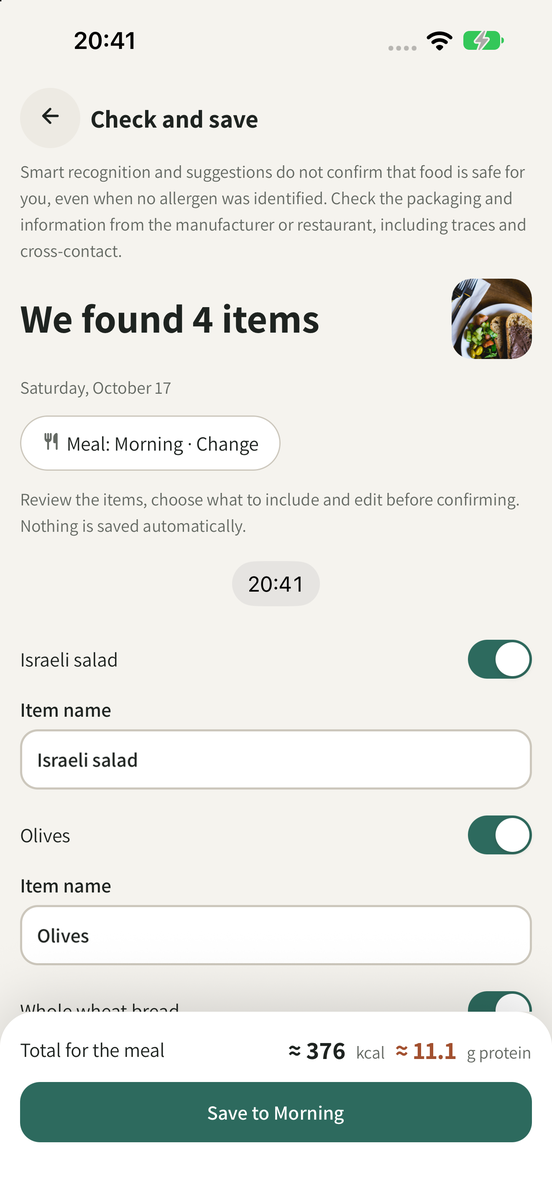
In Healthy+ there is a water button for quick logging. You can use it close to the time you drink and then check that the amount added matches what you meant to log. For example, after drinking from the glass you chose for work, you open the journal and record the amount. The button is a shortcut for documentation; it does not determine how much you should drink and does not verify the fluid status of your body. You can read more about a simple start in the food diary guide and about the app on the home page.
Frequently asked questions
Is a target in the app a personal medical recommendation?
No. A logging target does not replace guidance you received from a care team. If you are not sure what amount suits you, check with a professional who knows your situation, instead of guessing from progress in the journal.
Do you need to log every sip?
You do not have to choose that level of detail. You can log by a familiar drinking vessel or in another way that is convenient for you, as long as you understand what amount was logged and you do not add again something that was already documented.
What do you do when you did not log during the day?
You can continue from the next drink. If you remember a certain amount, you can log it cautiously; there is no need to invent an exact completion just so the day looks full.
General information about fluids, differences between people, and drinking throughout the day appears on the UK National Health Service website. The article and the app are not a substitute for personal medical or nutritional advice.
You can start with a glass you know and one clear log, and then check which routine suits you.