
Sabich Calories: What Goes Inside and Logging
Published: · 4 min read
Sabich is an interesting logging story: eggplant, egg, potatoes, salad, tahini and amba in a single pita. You can start from a description of the dish and the toppings you know about, and then check the estimate you get. There's no need to invent ingredients or to present certainty when you don't know the recipe.
Log the headline, not the list
Instead of detailing every item, write what you ordered, the way you'd say it to the vendor: “sabich in a pita with everything.”
For example: you're standing in line at the stall and it's easy to forget what you added. After eating, write one sentence about what was in the pita. What to do today: next time, log your sabich in one sentence, right after you eat.
Pay attention to two things: size and richness
Sabich in a small pita is different from sabich served as a plate. Toppings like tahini and amba also make a difference. You don't have to detail each one, but you can add a descriptive word: “a lot of tahini” or “no fries.”
For example: Saturday morning with a family sabich on the balcony. You write “sabich in a pita, a lot of tahini” and you're done. What to do today: choose two fixed words for describing quantity and toppings.
You can choose from a list
Sabich is a well-known Israeli dish, and it's worth searching for it in a list of ready-made dishes before you break it into parts. This saves time and gives a reasonable log.
For example: at a restaurant where you ordered a familiar dish, a short search in the list is faster than writing. What to do today: look for three Israeli dishes that you eat often, and check whether they're on the list.
No guilt
Sabich is a beloved street food, not something to fix. You log it, you look back after a week, and you decide what suits you. A reasonable estimate is worth more than precision that makes you give up.
Common mistakes when logging sabich
The common mistake is to break the sabich into seven components and get tired of it. Another mistake is to log only the pita and forget what was served with it, such as a drink or fries. And the third mistake is to wait until evening to log.
For example: sabich on a lunch break at the market, with a cold drink. Both items belong in the diary. What to do today: log the sabich and what you drank alongside it, in one sentence. That way the diary describes what actually happened, without too much effort. And if one day you didn't log, nothing happened; you carry on from the next meal.
What it looks like in Healthy+
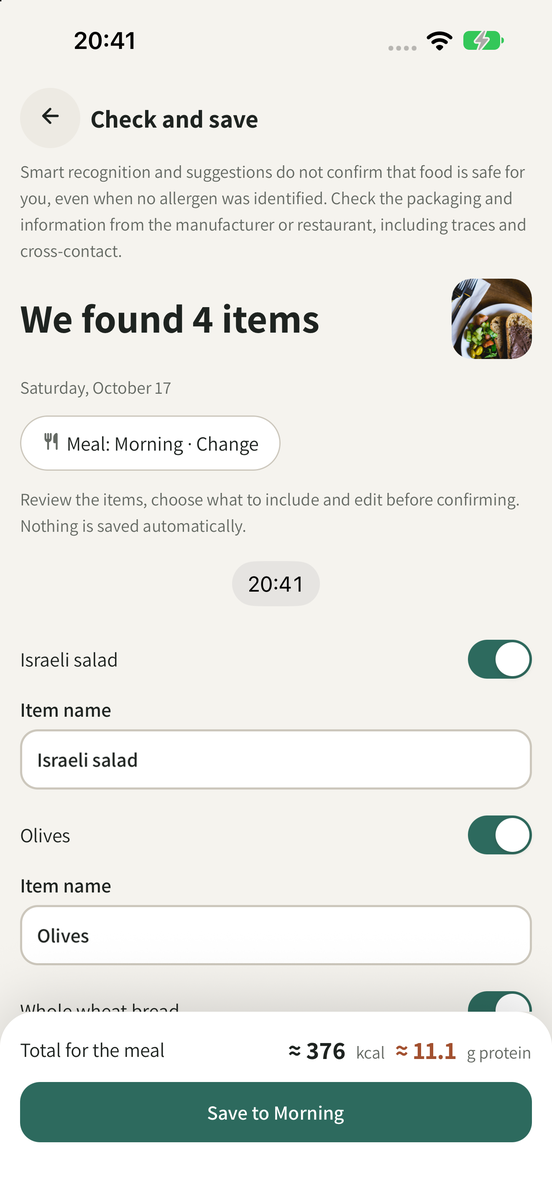
In Healthy+ you write or say a sentence in Hebrew, such as “sabich in a pita with everything,” or you photograph the plate. You can choose a dish from a database of dishes from Israeli restaurants. And you can also scan the barcode of products from the supermarket. The log is saved in your personal diary. Details about smart processing and backup appear in the privacy policy.
Frequently asked questions (FAQ)
Do I need to log every ingredient in the sabich?
No. A short description is enough, and you can correct it later.
Can I log a sabich I ate at home?
Yes. Write in your own words what was in the pita.
Does the app replace nutritional advice?
No. It is a food diary and is not a substitute for medical or nutritional advice.
Ready to log your next sabich? Healthy+ is waiting for you.